The Memory Police — VCE analysis
by Yoko Ogawa · guide written by Yahav Ben Yosef (raw 50 English, 99+ ATAR)
Ogawa's disappearances are so quiet that students often miss that the novel is about political violence. Nothing is shouted; things simply stop existing, and everyone agrees not to notice. That deliberate quietness is the technique to write about.
The themes that actually earn marks
Memory as identity
As objects vanish, so do the selves that were built around them. The narrator's gradual loss of her own body in the final movement takes the premise to its logical end and asks what remains of a person with nothing to remember.
Complicity and quiet authoritarianism
The islanders do not resist. They tidy away the disappeared objects. Ogawa's interest is in the psychology that makes obedience feel like decency — which is far more unsettling than a violent regime.
The novel within the novel
The typist losing her voice in the narrator's manuscript mirrors and predicts the outer story. Reading the two together, rather than treating the manuscript as a subplot, is what strong essays do.
Preservation, art and love
R's hidden room, the old man's care, the sculptures and the burnt books all present remembering as an act of love that can be practised even when it cannot win.
How to write about The Memory Police
Pay attention to how little emotion the prose carries. Ogawa's flat, gentle register during horrifying events is the argument — analysing tone rather than event is how you show an assessor you are reading the writing and not just the story.
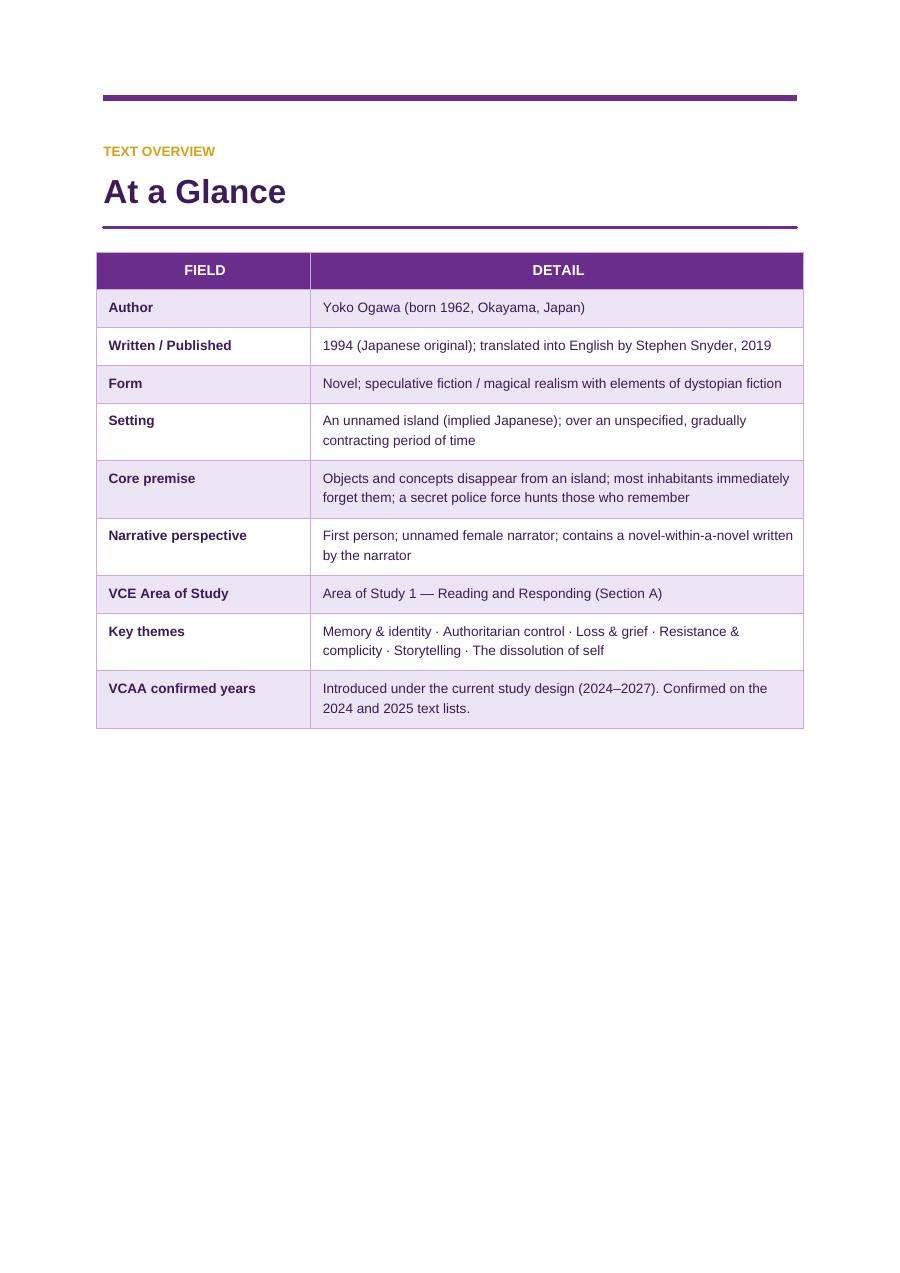
Read the first 3 pages, free
This is the actual 37-page guide our students study from — no email required. The full guide comes with a class spot.
The Memory Police — common questions
What are the main themes in The Memory Police?
Memory as identity, complicity and quiet authoritarianism, the mirroring novel-within-the-novel, and preservation or art as an act of love that cannot win.
Why is the novel within the novel important?
The typist losing her voice predicts and mirrors the narrator's own disappearance. Reading the two strands together, instead of treating the manuscript as a subplot, is what strong essays do.
How should I write about Ogawa's style?
Write about the flat, gentle tone during horrifying events. Analysing register rather than plot shows an assessor you are reading the writing, not the story.
We teach The Memory Police in our year 12 english tutoring classes — small groups, weekly marked essays, and the full guide included. You can also read our essay technique articles or see the class pricing.